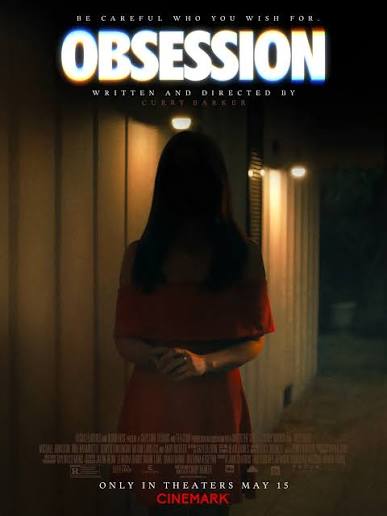
Being several months late to the discussion of a film, especially one as gushed over with praise as Obsession, tends to mean that a lot of the immediate interesting conversations have already taken place. With Curry Barker’s debut feature still successfully chugging away in theatres just shy of two months on now from it’s release though, there was one aspect of the film I felt hadn’t been discussed enough. For me, that was the aspect ratio. For a film that has caught the pulse of the zeitgeist so accurately, the internet was weirdly lacking in discussion on how this one choice had an impact on the film’s effect. So I thought I’d add some discussion that felt missing. In the context of The Odyssey’s arrival into cinemas, and the inevitable dialogues that has opened up about Nolan’s use of IMAX and it’s 1.43:1/1.9:1 aspect ratio, switching focus to a small indie film that is shot entirely in 3:2 feels somewhat counter-intuitive; but that’s where I think the more fascinating conversation is to be had, personally.
Principally, with the norm in film (and television) now settling on one of two ‘standard’ aspect ratios, the 1.85:1 flat widescreen for more dramas and comedies, and the 2.39:1 for action, sci-fi and other more panoramic looking releases, the choice by a filmmaker to buck this trend immediately sets itself on the line for trying to do something different. To use a very topical (and immediately dating reference), it’s the equivalent of walking up Downing Street and getting rid of the podium, notes, and auto-cue before giving your first speech. There is an immediate visual change that deep down in your brain you notice the effect of before ever quite acknowledge in words. A change that just slightly sets you off kilter with the world, leaving the niggling thought: “what’s different here?” And it’s that immediacy of being on edge that I think works so well for Obsession, and where so much of its chill then derives from after.
Much has been spoken, by those far more well informed than I, on the success of the film’s running theme of female agency, and the control men vehemently try to cling onto over it. The part of the narrative around this, I think has been missing is how much the film’s boxy frame adds to the terror of this. The film’s central conceit (and spoilers from here on out, you’ve been warned) of Bear being unwilling to release Nikki from the prison he has put her in for his enjoyment, is literally being framed by four tight walls. A claustrophobic square, forever squeezing all it’s inhabitants deeper and deeper into it. Bear’s cell for Nikki is literally being presented in front of our eyes and to an extent enabling it. Every time Nikki seems to snap out of her cell for a split second, the stratospheric leap that comes with it almost shoots her out of the frame. You can almost hear the thunk of her hitting the side of the frame and pushing her back down. Even from the first moment Nikki is introduced to us, not in the bar, but on the phone, her name is specifically cut off by the size of the box on Bear’s phone (incidentally, with only the “Fre” of her surname surviving the end – is she asking to be freed already?). Right from the start, we are never allowed to entirely know see Nikki for herself, we are only ever allowed to see her in the box that Bear, and to some extend Ian and Sarah, allow. Her introduction in the bar is framed so that the camera never lets us see her face whilst she’s talking, until Bear actively engages with here – the sides of the frame are literally cutting her out until the man who wants to control her decides it’s time for the frame to see her.
This motif follows Bear throughout the film. His car is all straight lines and sharp angles, inside and out, almost creating another boxy prison inside the first; a tesseract of male control. His apartment is framed that almost every room is seen directly facing a wall, trapping it’s inhabitants not just in the frame of the camera, but that of the walls behind them as well. The camera likes to linger on shots of people through doorways; as if it’s taunting the characters, trying to lull them into attempting to break through with no intention of ever letting them. The conversation Bear and Ian have in the music shop about Nikki is very deliberately framed so that she is in the doorway, ever present but out of focus until Bear and Ian decide to give the attention to her. The square of the camera’s eye is being stolen by the men in order to frame her in a way that they control – never giving her the agency of choosing when she is in control. There is never a moment in this film, apart from the very end, where we get to see Nikki for herself; every glance, every long stare, every half-covered notice is framed with something cut off or covered in darkness. Even in the moments of the men, and Sarah, trying to show they care about Nikki, they are in some way blocking her out, keeping her trapped to the side. In Sarah’s case this blockage is literally an opaque window designed to keep out not just Nikki, but the world around her and Bear.
The demonstration of this though that is the most horrific, is the final shot of the film; Nikki, holding Bear’s body is finally free of the spell. She has her agency returned and we finally get to see her for herself, and not at the behest of Bear. It’s in this moment that the film is at it’s scariest though; where we as an audience are aware that she’s back, and of what has transpired in that room over the last ten minutes, and are just waiting until it dawns on her as well. We’re allowed to sit in these few seconds with her, thinking that she is now going to have control over her story, until no, the camera slowly starts to rotate 180 degrees and comes to settle on the static of a TV whilst we hear her cries. Even in his death, she is kept from agency by the man who stole it from her. Death is not the liberty for her that it is for him, and never will be. Bear gets an ending; Nikki is stuck with without one forever.
I have now seen this film three times since it’s release, and each time found something more to love about it than I did the time before that. As a horror film, it is definitely one of the rare breed of films that are more scary each time you watch it; each time the run up to that final scene has felt more and more horrifying, and the moment of quiet before the realisation of Nikki’s lucidity kicks in feels like an ever stretching and ever unforgiving eternity. I think it’s also telling that this is the only film I’ve spoken to others about in detail who have also said they want to see it numerous times (hi Adrienne) – the struggle of trying to break free of a box seems to have the indelible effect of making the most creative outputs.


Leave a comment