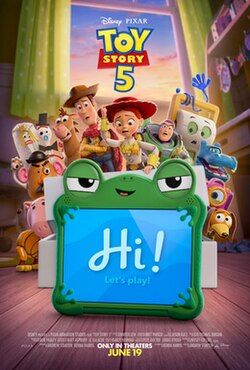
The question of ‘the best film trilogy’ seems to crop up in the more click-baity annals of the internet on a not so subtly recurring cycle, with the answer usually finding itself being one of the likes of the Before Trilogy, The Lord of The Rings, or The Few Dollars More films. But post 2010, my answer to that all so boring question has tended to be Toy Story; three films so perfectly written and put together that they have shaped both countless childhoods and adulthoods. Tales so well distilled from the most fundamental memories we go through that they themselves have become the very examples we use to guide each other through life. It’s telling that the last film to have been nominated for a best picture award at the Oscars (however stupid one finds the premise of them not being considered since) was Toy Story 3, arguably the trilogy’s most defining mark. For this writer, it is the film likely to have had the earliest continuing grip on one’s soul, with only a few bars of music needing to be played, whether in context or not, to bring me to a hideously sobbing mess. All of which means that the notion of walking into Toy Story 5 was all the more nerve wracking.
There are many ways of judging success for a film; does it entertain you? Does it make you laugh? Has it left an indelibly profound mark on your psyche? Has it done the bare minimum to pass the time? For me, this film had one bar to hit: don’t piss in the pool. This was admittedly the same bar I had going into its predecessor seven years ago, which thankfully succeeded, but for a film that immediately comes with such high quality baggage, not ruining the memory of the others is a big job. And, thankfully, I think it passes…just. This entry into Disney Pixar’s most beloved of tales is, for all intents and purposes, a well put together film that has just enough heart to connect with it’s audience and not spoil the memory of what has come before it. And if box office numbers are anything to go by, this will likely be biggest movie of the year, by some margin. Did I come out of it thinking that the entire genre had been re-written? No. Did I walk out with a warm fuzzy feeling of youthfulness? No. But did I walk out feeling more uplifted than when I had walked in? Yes. And it’s this reaction where I now find myself unsure what my definitive thoughts on this film are: not in the same bowled away nature of the first three, but also not in the same curiosity as the last one. And it’s in the next collection of words that I hope to find my opinion in real time with you Dear Reader. So, here we go.
Of the three other people whom I know to have watched Toy Story 5, I have only had conversations with two, and both have come out with much more firm thoughts. Neither had any trouble putting into words what they enjoyed, or thought was lacking, with the headlines being that Jessie was a standout, the Buzzes Lightyear (this being the plural for a collection of them being the small hill upon which I shall die – or at least one of them) carried the humour effortlessly, and the core narrative of modern tech having a not so subtly insidious agenda for children all struck the right chords. And all of those points are ones with which I concur. Jessie taking the spotlight felt earned and well overdue given how well written she is and how captivating Joan Cusak’s performance has always been. What with Woody taking a step back at the end of the last outing, promoting his faithful deputy to Sheriff always seemed like the right choice. Bringing in a more modern, tech enabled herd of Buzzes was a sheer delight, never quite breaking away from being one note, but crucially also never becoming tiring. Tackling the plight of an ever-invasive internet draining the way children learn to communicate with themselves, others, and the world through imagination feels like a brilliantly prescient move what with the backdrop of world governments attempting (however misguided the application) bans on the darker sides of the internet, akin to the forethought of Mission Impossible Dead Reckoning: Part One with AI. The music is for the most part great, the only outlier being a very jarring Taylor Swift song, all thanks to Randy Newman being forever faultless. All this is true even as I write it out now here, I still agree with all these points. Yet there still remains a part of me, however small, niggling at my brain, almost begging me to see something my eyes refuse to accept; that, this latest outing sacrifices something that none of the others before have: independence.
Now, don’t get me wrong, I am in no way trying to assert that none of the other films have relied upon things from their predecessors. By the very nature of sequels, emotional baggage, story beats, and metatextual nuances all flow through from one to another. The Good Doctor’s themselves, Kermode and Mayo, like to trot out the saying regularly that “we get from a film what we bring to it”, and, as such, we are forever going to bring opinions and emotional connections to characters and stories that we have seen before, when approaching any sort of sequel. The problem I keep coming back to with this film though, is that the filmmakers seem to have decided to try and take advantage of that; to utilise things from its predecessors that would elicit reactions from its’ viewers that it itself has not earned. My sticking point here comes from two specific uses of music throughout the runtime; the use of “When Somebody Loved Me” and “So Long” from the second and third films being played at rather crucial story beats. The intention with these pieces of music is clear and obliquely obvious from the creators, in so much as to try and elicit an emotional reaction to the images on screen using two very powerful compositions that shoulder a very weighty power in themselves: the ability to make one cry solely from the first four bars. And it is in these deployments that I find myself struggling, because how do I know that I connected with this film on it’s own merit over the shortcut the film took to my heart through those two musical lanes?
The YouTube creator Sideways has many videos on his channel discussing the use of music in films and the many techniques it has to enrapture itself in our feelings. But one video that I find myself rewatching with an uncommon frequency is his one on the music in Star Wars having the meaning behind some of it’s motifs retroactively changed, coining the term Thematic Re-contextualisation. What he concisely manages to distil with an understanding of music I would gladly die for, is that this technique can be used for both creatively expanding good, and creatively lacking laziness, with examples for both being:
- For the former, the use of Obi-Wan’s theme in Star Wars later being canonised as the Force Theme that we now know it as, particularly as Luke watches the Binary Sunset
- And for the latter, the stomach-turning re-use of the Yoda theme in the Rise of Skywalker to now be known as the ‘Let’s Lift a Ship out of Some Water with The Force’ theme.
In the context of my feelings around Toy Story though, it is the latter that I keep running into: in this latest outing, the use of both tracks from previous films never felt like they were used to propel the story forwards, rather being utilised to drill up emotions we all have buried away, instinctively brough back to the surface with the remarkable ease that melodies inherently have. To borrow the parlance of visual effects talk, this felt like listening into the Uncanny Valley with a boom mic. I knew what task the music was trying to accomplish, and it almost achieves it, yet it never sat entirely right with me. There was always an underlying unhappiness with my brain that couldn’t settle as much as I would have liked it to.
With all that being said though, I feel there is one more test that this film had to hit for me, one I wasn’t even aware I was grading it upon until I found myself a week out from viewing, and more conscious of the collective thought of the movie in the wild, particularly in the minds of those who’s opinions I trust most. That test, I now realise was simple; in the walk from the West End to Waterloo, was I an emotional wreck? Yes. In the last twenty minutes of the film, neither of the songs with which I took issue rear their heads, and the film plays out with the glorious overtures of Randy Newman’s skilled hand once again. We get led along by one with such a steady and trustworthy hand that the emotional reconciliation at the finale is one earned with enough good grace and punch that I needed the, rather disappointingly generic, Taylor Swift track over the credits to compose myself. Because at the end of the day, regardless of whether I think the story had cheated it’s way to my soul or not, arrive there it did in the end. The final minutes didn’t overstay their welcome with a key they hadn’t earned. The culmination of the tale felt natural and the logical conclusion for a gang so emotionally dear to all who have enjoyed their company that peril of any sense to them is going to leave its mark.
So Dear Reader, am I going to be ever comfortable with this film in its entirety? Probably not. But I think that’s okay. Because this Toy Story I don’t think is for me; those ones were the original three. Toy Story 4 and 5 are for the generation coming to these now. Getting to experience these characters in a theatre in the way they were meant to. For me, I think just being happy this didn’t piss in the pool is as good a result as I needed from it.


Leave a comment