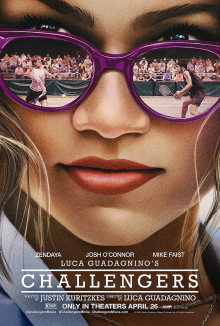
For most people in the UK, tennis comes down basically to Wimbledon for a fortnight in the summer. We hold out hope that Andy Murray will come storming through and make us all proud again, and then inevitably get bored after a week when it becomes apparent that that won’t be the case. Challengers sets out to change that. The matches played throughout have the intense, dogmatic anger of a gladiatorial match, constantly trying to find each other’s weakness and push as far as possible. And none of that stays in the court. The ever-changing time structure means that we are consistently seeing matches played out in heated conversations throughout the wider lives of our main characters, each one not just lambasting itself in double entendre, but also with a shower load of metaphor. This film for me made an actual tennis game interesting for once. The final showdown in the final act ranks up the tension so much that it suddenly drops into a new gear, reserved solely for the best thrillers, placing you right on the edge, genuinely unaware of how it’s going to turn out. The constant switching of camera placements, through every conceivable place one could out a camera (including in the ball itself), adds layer after layer of anger, passion and lust to each serve of the ball. By the time the closing credits come round, one almost feels justified in shouting out in glory as well (although obviously not in the cinema, code of conduct of course).
None of this though would be possible without the cast sitting at the centre of it, a cast with bottomless charisma and chemistry that one questions the very earthly possibility of. Each one is a remarkably convincing tennis player (if not all of them remarkably convincing teenagers), and they manage to not just pull off making the games feel real, but fill them with the passion and hunger that one would expect to see from professional players. But it’s in the quieter, more secluded moments that they really start to shine. Every kiss, every intimate moment is another point, with all three of them perpetually swaying back and forth between sets, trying to get the advantage and take the victory. Unsurprisingly though, it is Zendaya who shines throughout. Departing with evident enjoyment from the Disney/Marvel/Dune eras that have brought her here, we get her in a whole new dynamic – puppet master for her (as she calls it) two “little white boys”. Never at any point does she drop the ball, always holding the power in every scene and each conversation, so that O’Connor and Faist are constantly reaching for her standard (as their characters do with Tashi). The lust-triangle at the centre of all of it propels us forwards and if that wasn’t convincing then the rest of the story would fall apart. But it doesn’t. It enraptures us, digging it’s claws in and never letting go, as they each strike point after point against each other over the course of thirteen years. It’s this part where it does suffer it’s only real weakness though: timelines. The one match at the centre of the game is the backdrop for time jump galore. For the most part it works but its easy to get lost in the messiness of the backstories, with little more than title cards to give us an insight into what year/week/day it is at any point. For a story so minutely crafted as this, it’s mess that feels all the more apparent because everything else around it is so meticulously planned out.
Much is going to be made of the sexual politics of this film, by people far more qualified to make those judgements than me, so I’m not going to delve my toe too far into the depths of it. For me, the banner Challengers flies behind it is one of declaration that this the new standard for sports films. Forget just being a tennis film (farewell Wimbledon) we now have a new champion of the small, but widely varied genre. A bastion unwilling to sacrifice its general message to reach a specific audience, but rather one that stands firm in declaring itself at the forefront driving headfirst into a new era of movies but unafraid of that three-letter word, sex. These characters are all clearly attractive and they all clearly have excellent chemistry between each other. Their fleeting glances are at times declarations of war, and at others a deposition of lust, and sometimes even both at the same time. So much of the camera’s journey through this story is showing us the characters looking at each other but not showing us what they’re specifically seeing. We know that O’Connor and Faist’s characters are staring at Zendaya’s whilst she’s playing (made all the more obvious when the heads of their fellow grandstand viewers are constantly switching from side to side), but we aren’t given the option to see exactly what they see in her at that moment. For a film so focused on viewpoints, on silent messages in the twitch of a head, and the placement of a tennis ball, Challengers screams at the top of its lungs for us to understand that all tennis is sex, and all sex is tennis. A mantra that Robert California himself would be proud of.
 PLOTTIVE
Leave a comment